


AWISEL
Particle Counters
For airborne particle evidence in cleanroom classification, recovery time measurement and continuous monitoring workflows.
Where it fits
Measured evidence for invisible contamination.
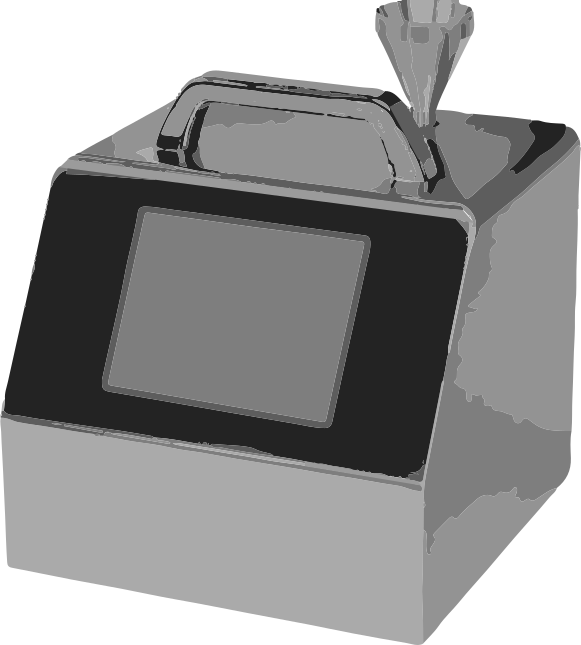
Particle counters help teams turn airborne contamination behavior into measured, documentable results. They are commonly discussed for cleanroom classification, recovery time measurement, continuous monitoring and investigation workflows.
The right configuration depends on channel sizes, flow rate, sampling strategy, reporting expectations and whether the work is routine monitoring or formal qualification support.
Sampling details
Start with the classification goal.
Share the cleanroom class, room state, test purpose and any monitoring expectation.
Sampling locations, volume, flow rate and repeat frequency shape the instrument configuration.
Clarify whether the output is for trend review, investigation, classification or recovery-test documentation.
Configuration factors
Particle counter selection.
Separate classification, monitoring and reporting needs before choosing a specific instrument.
Plan the sampling workflow
Room class, room state and sample volume shape the instrument and method discussion.
- Use: cleanroom evidence
- Focus: sampling locations
- Output: classification record
Define trend and reporting needs
Routine checks, investigations and recovery-test work each need a suitable data output.
- Use: monitoring support
- Focus: repeat frequency
- Output: report-friendly data
Need particle counter selection and training?
Tell us the room class, sampling points, reporting expectation and user team. We will help define the instrument choice and training scope.